A single pipeline hub in Louisiana sets the benchmark price for gas across an entire continent – understanding why says a lot about how this market, and the systems built to trade it, actually work.
Energy Trading & Risk Management Insights
Natural gas is one of the largest, most established energy markets in the world, and also one of the most physically constrained. It’s an abundant, clean-burning fuel that exists as a gas at room temperature, which sounds simple until you consider what that means operationally: because it’s a gas, it has to be contained in pressurized storage and moved through pipelines rather than trucked or shipped the way liquid fuels can be. That single physical fact – gas is hard to store and hard to transport – explains almost everything distinctive about how natural gas trades, prices, and settles inside an ETRM system.
What Natural Gas Actually Is
Physically, natural gas is a nonrenewable fossil fuel formed from decaying organic material trapped underground between layers of impermeable rock over millions of years. It’s primarily methane, but often contains meaningful amounts of ethane, propane, and butane alongside it – gas is called “dry” when it’s almost pure methane and “wet” when it carries substantial amounts of these heavier hydrocarbons. Because its composition varies so widely from field to field, natural gas is commonly traded in units of heat energy – British Thermal Units (Btus) or MMBtus – rather than in simple volume units like cubic feet. Roughly 1,000 Btus sit in a cubic foot of dry natural gas, and about 1 million MMBtus make up a billion cubic feet (Bcf), a conversion that underpins nearly every pricing formula in the gas market.
Why Pipelines, Not Trucks or Tankers
Methane’s low energy density per unit volume is the real reason pipelines dominate natural gas transport. A gallon of gasoline packs 124,000 Btus into roughly 0.13 cubic feet; the same energy content in natural gas at standard atmospheric pressure needs about 100 cubic feet of storage. Even compressing gas to the kind of pressure used in scuba tanks – 250 times atmospheric pressure – still leaves it needing about three times the storage space of gasoline, plus a heavy pressurized cylinder to hold it. Pipelines sidestep the problem entirely by providing a continuous feed at moderate pressure rather than trying to store the energy densely in one place.
Where pipelines aren’t feasible – moving gas across oceans, for instance – the gas is instead supercooled to roughly -260°F and turned into a liquid, a process called liquefaction. Liquid natural gas is far denser and carries substantially more heat energy per unit volume, which is what makes long-distance ocean transport practical, even though the gas has to be returned to its gaseous form before most consumers can actually use it.
Hubs, Citygates, and Why Henry Hub Matters So Much
Where two or more pipelines connect, that intersection is called a hub; where an interstate pipeline connects into a local distribution network, that’s a citygate. Most natural gas trading happens at one or the other. The single most important of these in North America is Henry Hub, located on the U.S. Gulf Coast at the interconnection of thirteen pipelines. Henry Hub is the delivery location for the NYMEX natural gas futures contract, and it functions as the benchmark for natural gas priced across the entire United States – much like the S&P 500 functions as a benchmark for U.S. equities. The key difference is that Henry Hub isn’t an average of anything; it’s the actual price of gas at one specific physical location, which is why natural gas prices elsewhere are so often quoted as a spread relative to it.
Firm vs. Interruptible: How Pipeline Capacity Actually Gets Sold
Because pipeline capacity is a genuinely limited physical resource, transportation contracts come in two forms. A firm contract guarantees the pipeline capacity will be available when needed. An interruptible contract allows transportation only when firm-contract holders aren’t using their full reserved capacity – useful for participants who can be flexible about timing, like a storage facility buying gas when pipeline usage is low and selling when it’s high. These contracts carry their own vocabulary worth knowing: a reservation charge (a fixed monthly fee for reserved capacity), a commodity charge (the variable per-unit transportation cost), and receipt or delivery adders (fixed price adjustments tying a specific point’s price to a nearby benchmark). Every one of these terms eventually becomes a line item that has to be captured accurately inside a trading and settlement system.
The Physical Value Chain: Who Does What
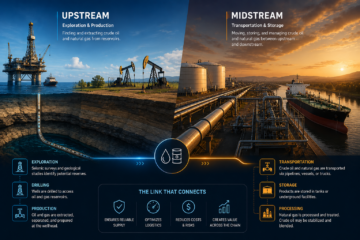
Getting gas from underground to a customer’s furnace involves a genuinely long chain of specialized businesses. Exploration companies search for reserves; drilling companies extract the gas and move it to a processing facility; processing plants strip out impurities and separate the raw gas into its component hydrocarbons; interstate pipeline and LNG transportation companies move the standardized dry gas to consuming regions; storage companies hold it in underground facilities until needed; and distribution companies deliver it to the end consumer’s meter. Most physical companies specialize in just one or two of these stages, because each is complicated enough – and different enough in required skill set – that being excellent across the entire chain is rare.
Trading itself is generally left to natural gas marketers – speculators and investors, often Wall Street firms or spin-offs from integrated energy companies, who buy and sell gas without necessarily touching the physical infrastructure. Marketers carry substantial specialized knowledge: arranging storage and transportation, managing legal agreements across multiple counterparties, and continuously monitoring counterparty creditworthiness. That’s precisely the operational load an ETRM platform is built to absorb – tracking contracts, transportation arrangements, and credit exposure across a wide and shifting set of trading relationships.
Extraction: From Rock Formation to Wellhead
Not all underground rock holds gas equally well. Porosity describes how much empty space exists within a rock as a percentage of its total volume; permeability describes how well those pores connect to each other, allowing gas to actually flow toward a well rather than sitting trapped. Porous rock with poor permeability – imagine a foam coffee cup, insulating precisely because air is trapped in disconnected pores – won’t yield gas easily even if it holds plenty. Hydraulic fracturing solves this by injecting fluid into a rock formation and creating controlled microfractures, turning previously impermeable rock into a producible reservoir using conventional drilling techniques afterward.
Why This All Matters for Trading Desks
Every element described here – Btu conversion, hub-based pricing, firm versus interruptible capacity, the multi-stage physical supply chain – eventually has to be represented accurately inside a live ETRM system as a deal, a transportation contract, or a basis differential against Henry Hub. A trader who understands why a delivery point trades at a premium or discount to Henry Hub, or why interruptible capacity behaves differently from firm capacity in a tight market, brings real context to what would otherwise just be a number on a screen. For traders and analysts looking to connect this physical and market structure knowledge to actual platform configuration, Endur training course covers deal capture, position management, and transportation-related workflows inside the ETRM system many energy trading desks run in production.
Key Takeaways
- Natural gas trades in energy units, not volume – Btus and MMBtus are the standard, since gas composition varies too much from field to field for volume alone to be meaningful.
- Pipelines exist because of low energy density – methane simply doesn’t pack enough heat energy per cubic foot to make trucking or standard containers practical.
- Henry Hub is the anchor price for an entire continent – a single physical location, not an average, against which most other North American gas prices are quoted as a spread.
- Firm and interruptible transportation contracts serve very different needs – guaranteed capacity versus flexible, opportunistic access to unused pipeline space.
- The physical supply chain is long and specialized – exploration, drilling, processing, transportation, storage, and distribution are typically handled by different companies, with marketers bridging the trading side.
This article discusses natural gas market fundamentals from published industry literature on energy trading and investing. It is intended for informational purposes and does not constitute trading or investment advice.

0 Comments